Both types work great. The right choice depends on your home, household size, budget, and how you use hot water. We install both and have no stake in which one you pick. Here's everything you need to know.
We serve homeowners in Jenison, Grandville, Hudsonville, and throughout West Michigan - and in this area, local water conditions play a bigger role in that decision than most guides acknowledge.
We'll recommend the right option for your home - no upsell.
A quick overview before we go deeper on each.
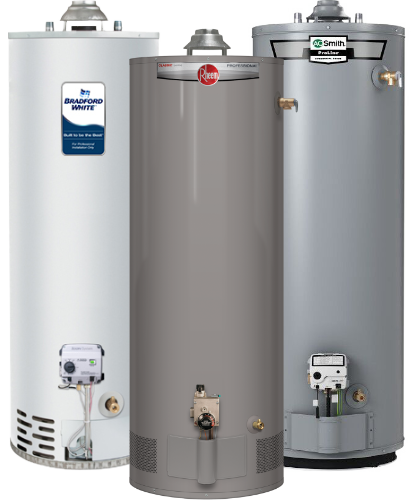
Storage Tank
Gas · Electric · Propane
Best For
Most West Michigan homes. Affordable, reliable, and simple to maintain. The right choice when upfront cost matters or your home already has a tank setup.
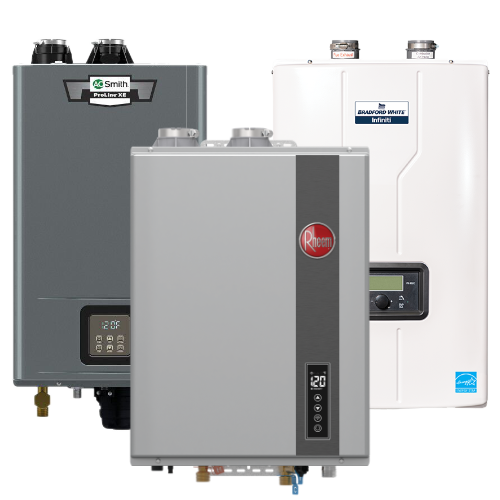
On-Demand
Gas · Propane
Best For
Larger households, long-term homeowners, or anyone who's frustrated by running out of hot water. Higher upfront cost but can last 20+ years.
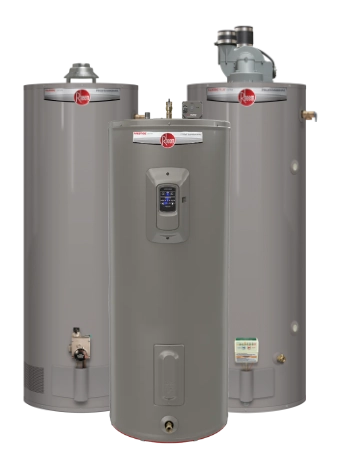
A storage tank water heater keeps 40–75 gallons of water heated and ready at all times. A gas burner at the base (or electric elements inside the tank) maintains your set temperature around the clock. When you turn on a hot water tap, pre-heated water flows out immediately.
It's the most common type in West Michigan homes by a wide margin - and for good reason. They're simple, affordable, and easy to service or replace.
Advantages
Limitations
Who should choose a tank?
Most homeowners - especially if you're replacing an existing tank setup, want a straightforward same-day install, or prefer a lower upfront cost. A properly sized tank handles the hot water needs of the vast majority of West Michigan households without any issues.
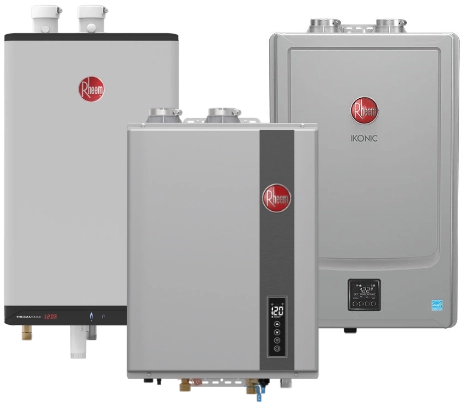
A tankless unit heats water on demand as it flows through the unit - there's no storage tank to fill or maintain. When you turn on a hot tap, cold water travels through a heat exchanger and comes out hot within seconds. The supply is continuous: as long as you're running the tap, you have hot water.
Tankless units in the Grand Rapids area are almost exclusively natural gas or propane. They mount to the wall and take up a fraction of the space of a tank. The tradeoff is a higher installation cost and more complex venting requirements.
Advantages
Limitations
Who should choose tankless?
Homeowners who regularly run out of hot water, have a large household, plan to stay in their home long-term, or want to free up utility space. The economics make the most sense when the unit gets heavy daily use and you can recoup the installation cost over a longer lifespan.
| Feature | Tank | Tankless |
|---|---|---|
| Hot water supply | Finite (40–75 gal) | Endless on demand |
| Upfront cost | Lower | Higher |
| Installation complexity | Standard | More complex |
| Fuel types available | Gas, electric, propane | Gas & propane only |
| Typical lifespan | 10–14 years | 20+ years |
| Space required | 24" x 24" footprint & 60"+ tall | Wall-mounted, compact |
| Standby energy use | Yes - always heating | None - heats on demand |
| First-hour hot water | Immediate from stored supply | Seconds after flow starts |
| Same-day installation | Yes - most cases | Depends on venting/gas |
| Best value | Smaller households or short-term homeowners | Larger households or long-term owners |
Here's a simple way to think about it. If you're still not sure, just call us - we'll give you a straight recommendation based on your specific situation.
Our technicians work with both types every day and have no preference either way. Call us, tell us about your home, and we'll give you a straight answer on which makes more sense for your situation - with pricing for both if helpful.
616-315-0999Ready to get a local quote? See what a full installation looks like in your area: Jenison, Grandville, or Hudsonville.
West Michigan - including Hudsonville, Jenison, and Grandville - has some of the hardest water in the United States. That one fact changes how long your water heater will last, how often it needs maintenance, and which type makes more sense for your home.
What does "hard water" actually mean?
Hard water carries a high concentration of dissolved minerals - mainly calcium and magnesium - picked up as groundwater travels through the limestone and dolomite bedrock common in Ottawa and Kent counties. You've probably seen the effects already: the white crusty buildup around faucets and showerheads is mineral scale. The same process happens inside your water heater, just where you can't see it. In this area it's also common to find elevated iron (leaves rust-colored staining) and hydrogen sulfide - the source of a rotten egg smell from hot water taps.
Storage Tank on Well Water
Scale builds up at the bottom of the tank where it's heated. It acts like an insulating blanket - the heater has to work harder to push heat through, wasting energy and eventually overheating the elements. The sacrificial anode rod (an internal metal rod that protects the tank lining from rust) gets consumed much faster by mineral-rich water. Tank units that last 10–12 years on city water can fail in 7–8 years on untreated well water.
What protects it
Tankless on Well Water
Tankless units have no tank interior to corrode - but they do have a tightly coiled heat exchanger: narrow passages that flash-heat water on demand. Those passages are especially vulnerable to scale buildup. Sediment and iron from a well can also clog the inlet filter screen and confuse the flow sensor. And because well pumps cycle on and off, they create pressure swings that can make a tankless heater fire and cut out erratically.
What protects it
On city water in Grandville or Jenison?
City water in the Kent County corridor - Grandville, Wyoming, Grand Rapids - is still moderately hard (around 100–130 ppm) but treated and consistent. Tank units here typically reach their full 10–12 year lifespan with standard maintenance. The well water precautions above are still a good idea but less urgent. Tankless on city water is a simpler, lower-maintenance install.
Have a private well? Municipal water quality reports are a useful starting point, but private well water varies significantly by lot, depth, and season. Before choosing a water heater type, we recommend testing your water for hardness, iron, and sulfur through a certified lab or your local health department. Knowing your actual numbers lets us size the right pre-treatment for your install and avoid surprises.
The right choice can depend on where you live - a Jenison home on well water often has different considerations than a Grandville home on city water. See what's typical in your area:
Trusted by homeowners in Grand Rapids and across West Michigan.
“Immediate and professional response. Did not try to oversell, merely met my needs and verified functionality thoroughly.”
- Allison K., Grand Rapids
“Efficient, friendly, and fair.”
- Sue M., Grand Rapids
“Very easy to work with, great quality, stuck to estimates, very professional, no bs.”
- John S., Dorr
“Great customer service. Did all work quickly and professionally. They cleaned up afterward and even replaced custom insulation.”
- Eric V., Holland
“Showed up on time, knew what he was doing, got the job done quickly, on budget and completely.”
- Dane B., Ada
“Took the time to educate us so we could be empowered, not overpowered. I want you to know how impressed I was by his integrity.”
- Laura B., Hudsonville
You can compare prices using our Exact Quote Tool to see the real installed cost for your specific home and preferences. Tank water heaters typically have a lower upfront cost, with most installations in the $1,500–$2,995 range depending on size and fuel type. Tankless units generally start around $3,995 installed, largely due to the additional labor for venting and gas line upgrades. However, tankless units can save money over time through energy efficiency and longer lifespan.
It depends on your home's existing gas line size and venting setup. Tankless units often require a dedicated larger-diameter gas line and a new PVC venting run, which adds time and cost. In some homes it's straightforward; in others it requires more prep work. We'll assess your setup and give you an honest timeline before committing.
Whole-home electric tankless units require extremely high amperage (often 150–200A dedicated) that most West Michigan homes aren't wired for. We install gas and propane tankless units only. If your home is electric and you want on-demand performance, we can talk through your options - including right-sizing a high-efficiency electric tank.
With regular annual maintenance (mainly descaling the heat exchanger), tankless units routinely last 20–25 years. The main serviceable components - the heat exchanger, igniter, and flow sensor - can all be replaced individually, which is why the lifespan is so much longer than a storage tank.
A cold water sandwich is a brief burst of cold (or lukewarm) water that can occur when you turn a hot tap on and off quickly in succession. It happens because the tankless unit briefly re-fires and the residual warm water in the pipes is followed by a slug of cold before the unit heats up again. It's a minor quirk most people adapt to quickly, and it's less noticeable in larger households with more continuous hot water use.
Yes - if back-to-back showers, laundry, and a dishwasher all run at once, a tank can be depleted. A properly sized tank for your household (which we help you select) minimizes this significantly. If you're frequently running out, it often means you need a larger tank or should consider switching to tankless.
Tankless repairs are generally more expensive - the parts (heat exchangers, control boards, flow sensors) cost more, and the diagnosis is more involved. That said, tankless units often last longer. Tank repairs are cheaper per visit, but tanks are more likely to reach a point where repair isn't worth it.
Serving Jenison, Grandville, Hudsonville, and all of West Michigan - tank and tankless installs. Get your exact installed price in 30 seconds.